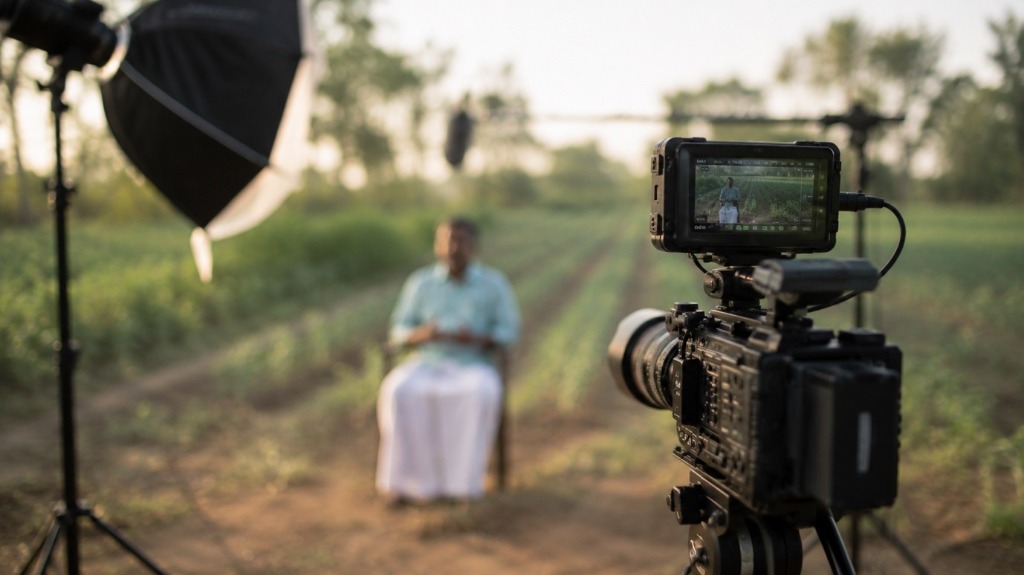
One day in August 2025, I received a call from a creative agency based in the United States. They needed a testimonial video filmed at a customer's facility in Bhavnagar, Gujarat. On paper, it looked like a straightforward assignment. In reality, it would become a reminder of one of the biggest challenges of shooting remotely in India.
For those unfamiliar with the geography, Bhavnagar is a significant industrial city, but when it comes to professional video production infrastructure, the nearest major hub is Ahmedabad.
The brief sounded straightforward.
The agency would provide a questionnaire. Our job was to conduct the interview, draw out meaningful responses from the customer, and capture enough supporting footage to tell a compelling story. Beyond the interview itself, the shoot required extensive b-roll footage of the machinery in operation, the manufacturing processes, the facility, and enough visual elements to establish scale and context.
The Challenge
Like many projects, this one came with a challenge. Budget.
The client was keen on keeping costs under control and wanted to minimise crew travel expenses.
"Can we hire someone locally?" he asked.
It was a fair question.
I explained that while Bhavnagar certainly had videographers, finding the right combination of equipment, production experience, interview skills, lighting knowledge and industrial filming expertise could be difficult. A testimonial video intended for an international audience demands more than simply recording footage. It requires understanding how to tell a story visually and how to present a business in the best possible light.
The client understood my concerns, but the budget remained the overriding factor.
"Let's explore local options," he insisted.
So we did.
One of our team members began contacting local vendors.
"Wedding videographers are available," my client relations manager reported after several conversations. "They can shoot with the camera settings we suggest. But conducting the interview and achieving the visual style the client expects might be challenging."
Her concern was valid.
A camera is only one part of production. Knowing where to place it, how to light a subject, how to frame a shot, how to make an interviewee comfortable, and how to identify visuals that support the narrative are skills developed through years of experience.
Nevertheless, the agency decided to proceed with a local vendor.
To be fair, the decision was understandable. If a company in Gujarat can source industrial equipment locally, why fly equipment halfway across the world? From a purely budgetary perspective, the logic seemed sound.
The Execution
At some point, I stepped back and allowed the agency to coordinate directly with the local videographer.
That is when the first challenge surfaced.
Communication.
The agency was based in the United States. The videographer was local. Even basic discussions around shot composition, interview framing, lighting requirements and production expectations became difficult. The agency frequently called us seeking clarification, while the local vendor often reached out to us to interpret what the client was trying to achieve.
Experience cannot be hired overnight. These are skills that come only with years of practice.
On the day of the shoot, my phone rang.
The client had received a few sample images from the location and wanted my opinion.
The problem was immediately obvious.
The framing was far removed from what the agency expected. The lighting was flat. The shots lacked depth. The cinematic visual style they had envisioned was well beyond the videographer's understanding and experience.
At the client's request, I spoke directly with the videographer and tried to guide him through the process. To his credit, he genuinely tried his best. He was cooperative and willing to learn.
The Aftermath
The shoot concluded.
Two days later, the agency called again.
The footage was not usable.
Technically, the files were fine. The camera had recorded. The audio existed. The facility had been filmed.
But the footage did not align with the expectations of either the agency or their client. It lacked the visual quality, consistency and storytelling value required for the final film.
After several discussions, the decision was made.
The project would be reshot.
This time, my crew travelled from Mumbai. So did I.
We filmed the facility, captured the required b-roll, conducted the interview, directed the responses, and ensured that every frame supported the story the client wanted to tell.
The final outcome met expectations.
The Reality
What continues to surprise me is that people instinctively understand quality differences in almost every other industry.
Most people can tell the difference between a gourmet restaurant and a roadside eatery.
They can distinguish between an economy car and a luxury vehicle.
They understand the gap between a tailored suit and an off-the-rack alternative.
Yet when it comes to video production, even experienced professionals sometimes assume that anyone holding a camera can deliver the same result.
The reality is very different.
Equipment can be rented. Cameras can be purchased. But experience cannot be hired overnight.
Knowing how to interview a factory owner. Understanding how industrial operations should be filmed. Anticipating client expectations. Managing lighting challenges inside active manufacturing environments. Creating footage that serves both marketing and storytelling objectives. These are skills that come only with years of practice.
The Solution
This does not mean every remote shoot requires flying a full crew across the country.
In many cases, local resources can work brilliantly when supported by proper planning, supervision and realistic expectations.
The key is to evaluate the risk before the shoot begins.
Ask a simple question: What is the cost of getting it wrong?
A reshoot almost always costs more than doing it right the first time.
For remote productions across India, we often help clients assess locations, identify local capabilities, recommend the right production approach and decide when travel is truly necessary. Sometimes the answer is local. Sometimes it is not.
The objective is never to spend more.
The objective is to ensure that when the footage arrives in the edit suite, it tells the story the client wanted to tell in the first place.


